Dalil — دليل
Your guide to every government service — in one conversation.
A concept for AI-first federal service delivery in the UAE: one multilingual assistant that answers in plain language, cites its official sources, and completes real transactions across entities. It doesn't ask residents to know which authority owns which step.
Alignment with national strategy
Dalil is designed against the UAE's stated direction for AI in government, not around it. The National AI Strategy 2031's eight objectives include employing AI in customer services to improve quality of life, providing a data-driven infrastructure, and optimising AI governance and regulation. Those three are the ones a service assistant lives or dies by.
AI across customer-facing services
The strategy emphasises integrating AI into government services to improve efficiency and citizen experiences.
Smart government
A push toward 100% paper-free, predictive public services across all emirates.
Data sharing & governance
Interoperable, secure datasets across entities, with certification of ethical compliance.
Centennial 2071 & quality of life
AI is framed as a national priority to enhance government performance and improve quality of life, linked to the Centennial 2071 agenda.
Designing AI residents can trust
A government assistant carries a higher burden than a consumer one: a wrong answer costs a resident money, a visa, or a day of work. Four principles carry the design.
Grounded, never improvised
Every substantive answer shows its official sources inline (ICP, GDRFA, u.ae) as tappable chips. Requirements, fees and timelines read as quotations from authority, not generated prose.
Verified identity, verified session
UAE PASS sign-in turns a general answer into the resident's own case: their ID, their expiry, their fines. A "verified session" header makes clear when the assistant is acting on real records.
One human approval per commitment
AI prepares; the resident decides. Fees are itemised before a single confirm button, and a multi-entity plan is approved once. Then the machine does the coordinating.
Language as a right, not a setting
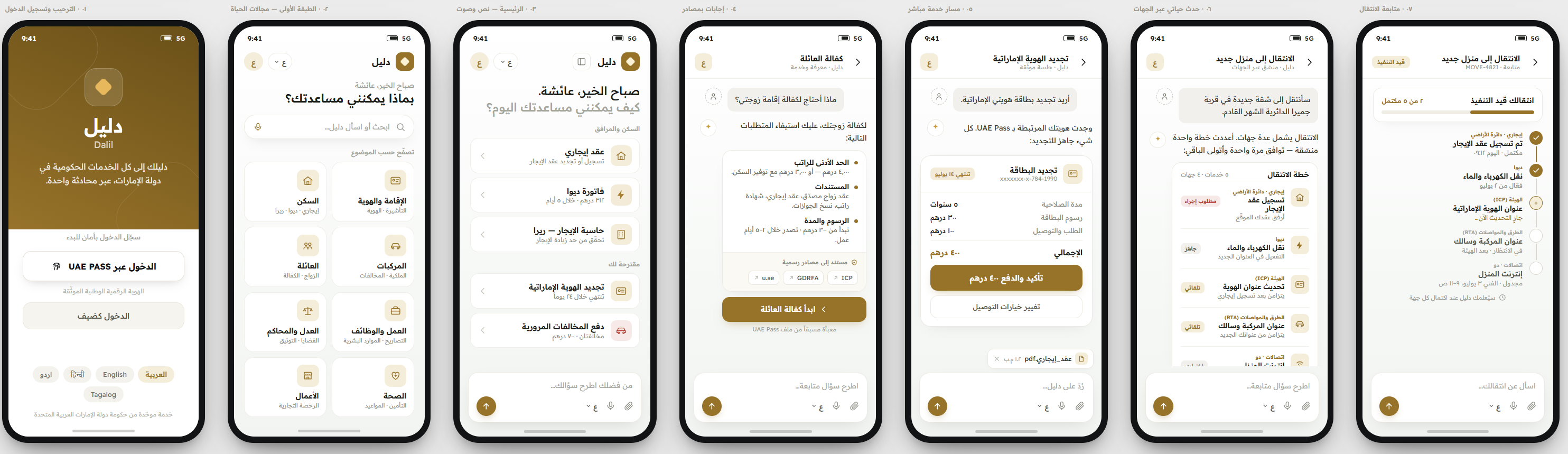
Arabic and English are equal citizens of the interface, with Hindi, Urdu and Tagalog for the UAE's resident majority. Voice mode detects the spoken language and answers in it.
The product
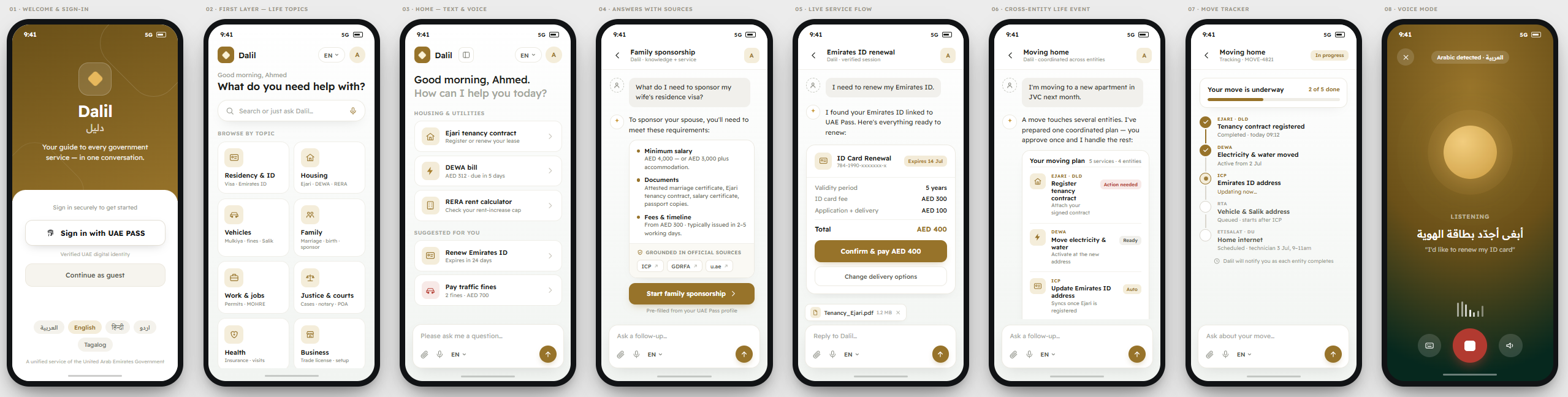
Eight screens carry the concept, from sign-in through life-event coordination and voice. Designed multilingually from the first frame: the Arabic set is a mirrored layout, not a translated one.
The government, arranged around your life
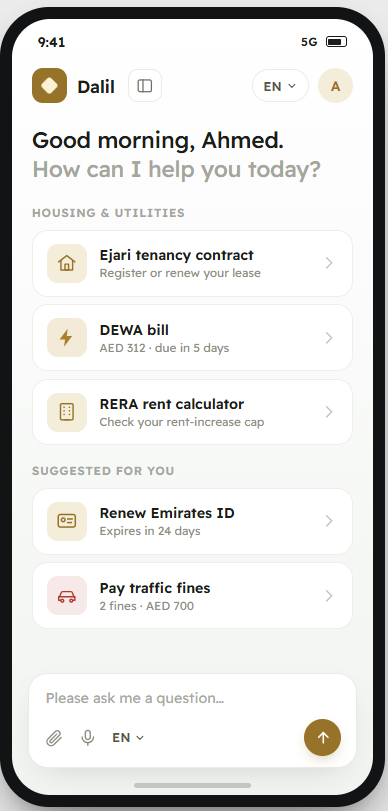
No department names, no service catalogue. The home screen groups what's live for this resident: housing and utilities, then what's coming due, with the conversation input always at the bottom. Life topics (Residency, Housing, Vehicles, Family, Work, Justice, Health, Business) replace the org chart as the first layer.
- Proactive cards carry the consequence, not the label: "Expires in 24 days", "2 fines · AED 700"
- Ask-or-browse in one place: search, topics, and free conversation are the same field
- Language switch and profile sit in the header, one tap, on every screen
From question to completed transaction, without leaving the conversation
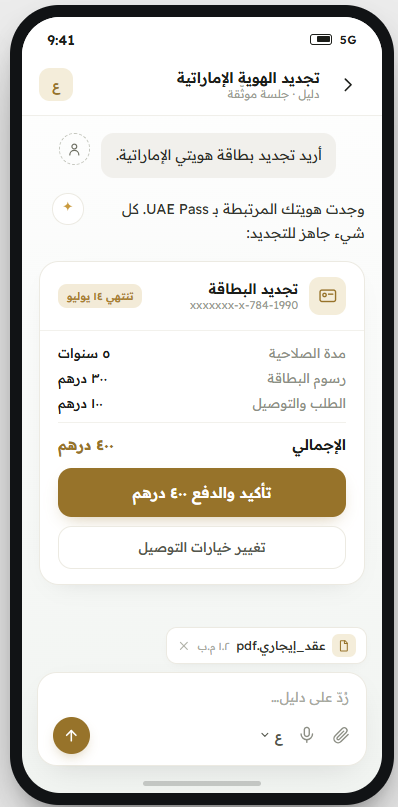
"I need to renew my Emirates ID" resolves to the resident's actual card, pulled from UAE PASS, with validity, itemised fees and delivery options, then one confirm-and-pay. The AI assembles; the resident approves. Documents from an earlier step (the tenancy contract) travel with the session.
- Fees always itemised before the commit, never a single opaque total
- "Verified session" labelling so the resident knows real records are in play
- Pre-filled from the UAE PASS profile, with every prefill visible and editable
The cross-entity life event
Moving home is the concept's hardest test. Today it means five services across four authorities, each with its own portal, sequence and dependency. Dalil turns it into one plan the resident approves once, then tracks.
Each step carries its real state: Action needed, Ready, Auto, Queued · starts after ICP. The resident sees what is waiting on them versus on the state.
The move tracker shows 2 of 5 done with entity attribution and timestamps. Automation without visibility is what makes government AI feel unaccountable.
Voice mode detects the spoken language, transcribes it, and shows the interpreted intent in English underneath, so a resident with low literacy in any script can still confirm what was heard.
What I'd validate next
Test whether source chips actually raise confidence, or read as legal noise. Compare against an unsourced answer with the same content.
A single approval for a five-service plan is efficient but a lot of delegated authority. Test where residents want to be asked again.
Run the mirrored build with Arabic-dominant residents, on voice as well as text. Mirroring is easy; idiom and formality register are not.