Vaxera
Never miss a vaccine again.
A digital vaccination passport for families and clinics. AI reads a paper vaccination card and turns thirty years of handwritten records into a verifiable, bilingual history that works offline. I designed it end to end, from the survey research through to the product, the business model and the investor pitch.
A public health problem hiding in a lost piece of paper
A child's entire immunisation history lives on one folded card. Lose it and the record is gone, so doses get repeated, skipped, or guessed at from a doctor's memory.
"I lost my son's vaccination card twice. I had to ask the doctor to remember what he took."
Research first, product second
Egypt market survey, N=45, April 2026, run before any screen was designed. Nearly a quarter of respondents volunteered for follow-up interviews, which is itself a signal about how much the problem stings.
Written the way people actually speak, branched by role
The survey is written in everyday Egyptian Arabic, not the formal kind from textbooks. It's the way people actually answer. 33 questions, 5–7 minutes, fully anonymous, and branched at question one so nobody reads a question that isn't theirs.
How they store records today (paper card, phone photos, notebook, the clinic's memory, or not at all); what has gone wrong in the last two years; how they remember the next dose; then two 1–5 scales (the stress of managing appointments, and their confidence the child is up to date), and how hard a same-day school or travel certificate would be to get.
Whether they even know which vaccinations they've had; the moments they were asked to prove it (travel, visa, a new job, university, a medical procedure); how easily they retrieved the record last time and where it lives; whether a booster was delayed by uncertainty. Then a 1–5 scale on how much the inaccessibility bothers them, and an open story field.
Role and setting, weekly vaccination volume, and what they record with today: paper only, Excel, clinic software, the government system, or a hybrid. Then the operational truth: how often patients arrive without complete records and what staff do about it (ask the family, call the previous clinic, re-administer to be safe), the top three record-keeping challenges, weekly hours lost to vaccination paperwork, stock management, whether a dose was ever refused or delayed over records, and a 1–5 satisfaction rating on their current method.
Almost every question asks what happened, not what they'd like: "in the last two years, which of these happened to you?" People misreport preferences; they remember incidents.
Each multi-select ends with an explicit none option, so the data can distinguish a real zero from a skipped question, and the 67% figure means something.
Every path closes with an optional story prompt. That's where the Cairo parent's quote came from, and where the follow-up interview list built itself.
Record loss outranked reminders. So digitising the existing paper card became the product's first job, not scheduling, which is where similar apps usually start.
A third struggled to prove vaccination: for schools, travel, nurseries. That made QR verification a core surface rather than a feature.
Providers losing hours weekly meant the clinic side couldn't be an afterthought. The same record has to serve a parent and a nurse with different needs.
The AI moment: a photo becomes a record
The scanning flow is where trust is won or lost. AI extraction is fast but fallible, and a wrong dose date in a child's immunisation history is unacceptable. So the design makes the machine's confidence visible and puts the parent in the loop before anything is saved.
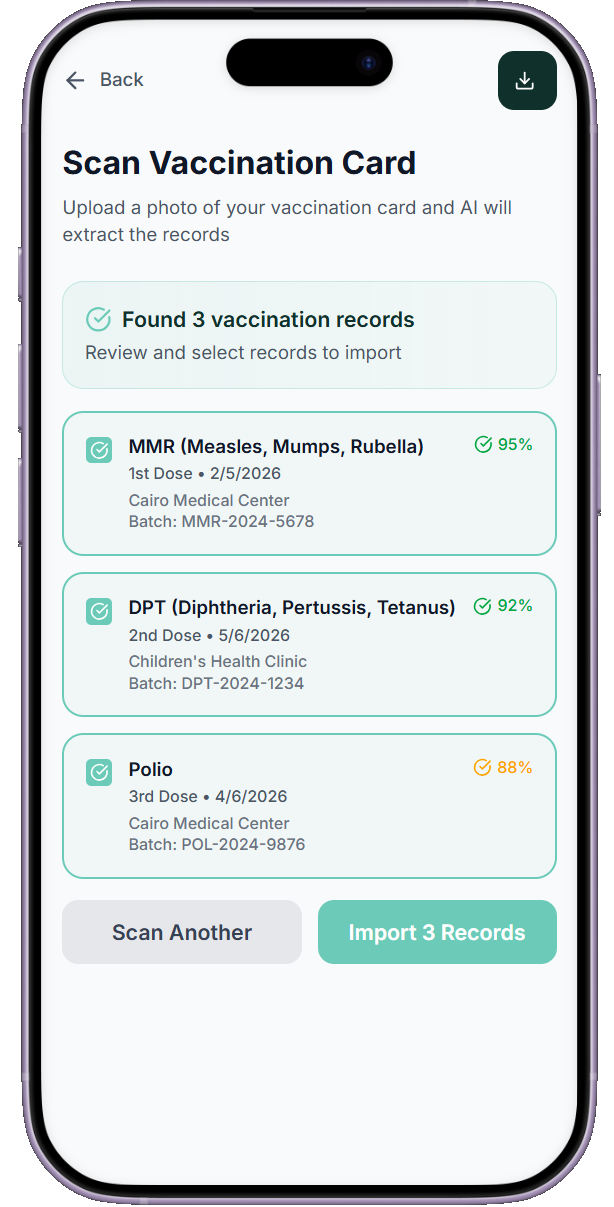
Each extracted vaccination carries its own score (95%, 92%, 88%) rather than one blanket "scan successful". The 88% is visually distinct so attention lands where verification is needed.
Nothing enters the record automatically. Records are selectable, and the primary action states exactly what will happen ("Import 3 records"), so the count is confirmed, not assumed.
Each row shows dose number, date, clinic and batch number: the details a parent can check against the paper card in their hand. Verification is possible without medical knowledge.
"Scan another" sits beside import as an equal option, because paper cards are folded, faded and often multi-page. The flow expects several passes rather than treating a partial read as failure.
One app, three experiences
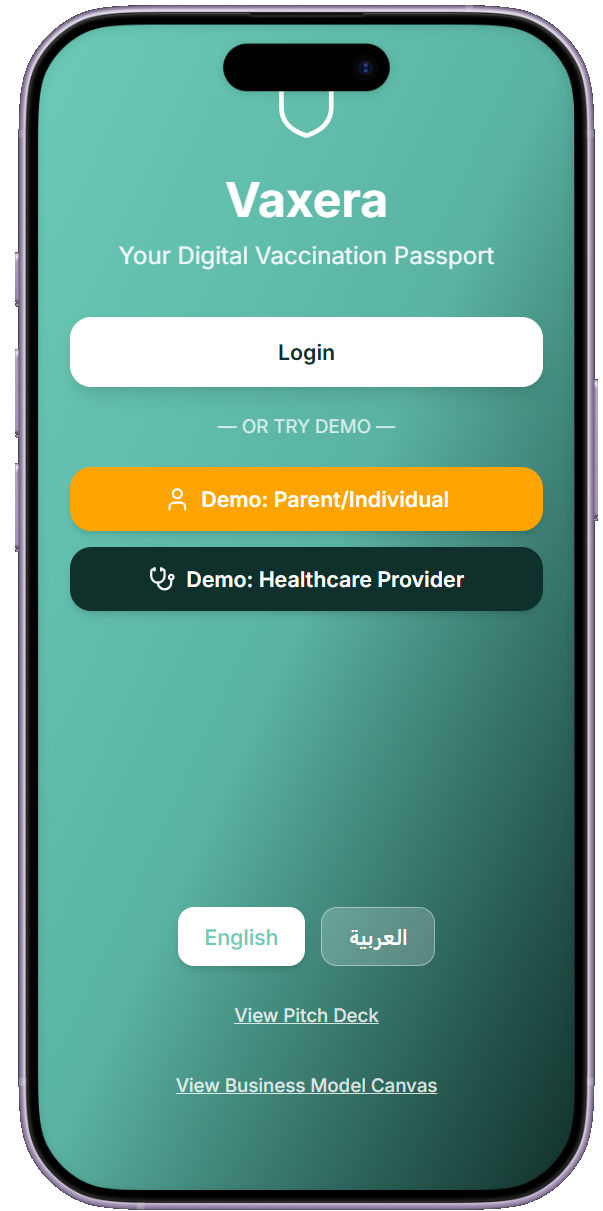
A parent, a healthcare provider and an institution touch the same record with different needs. So the app opens by asking who you are, and the demo modes let an investor or a clinic see their own side immediately.
The family's record
All dependents in one place, AI card scanning to import history, smart reminders for what's next, and QR proof when a school or airline asks.
The clinic's hours back
Verified history at the point of care, so a nurse stops reconstructing a record from memory, and duplicate doses stop being administered.
Proof without paperwork
QR verification replaces photocopied cards at enrolment: the use case a third of surveyed parents named as their hardest moment.
Arabic and English are equals, with the right-to-left layout built in from the start. The language switch sits on the entry screen, not buried in settings.
Records and QR proof resolve without a connection. A clinic corridor or a school gate is exactly where the network fails.
Two demo modes on the launch screen let a parent or a clinic see the value before creating an account. That matters for a health product asking for a child's data.
Designing the business, not just the app
The concept was taken through to a market case and an investor narrative, the part of product work that decides whether a good design ever ships.
A million children with a digital record they cannot lose. The duplicate doses, missed schedules and unprovable histories that come with paper, gone with it.
What I'd validate next
Test extraction against genuinely difficult cards (faded ink, Arabic handwriting, multi-page, water damage) and measure whether the confidence scores are honest.
Interview parents on what they need to see before uploading a child's medical history. The demo modes are a hypothesis about that, not an answer.
Shadow a busy vaccination clinic: does verified history actually save the 2–5 hours a week, and who at the desk has time to scan?